
Service Based Business Society Blog
ENTREPRENEUR ARTICLES AND RESOURCES
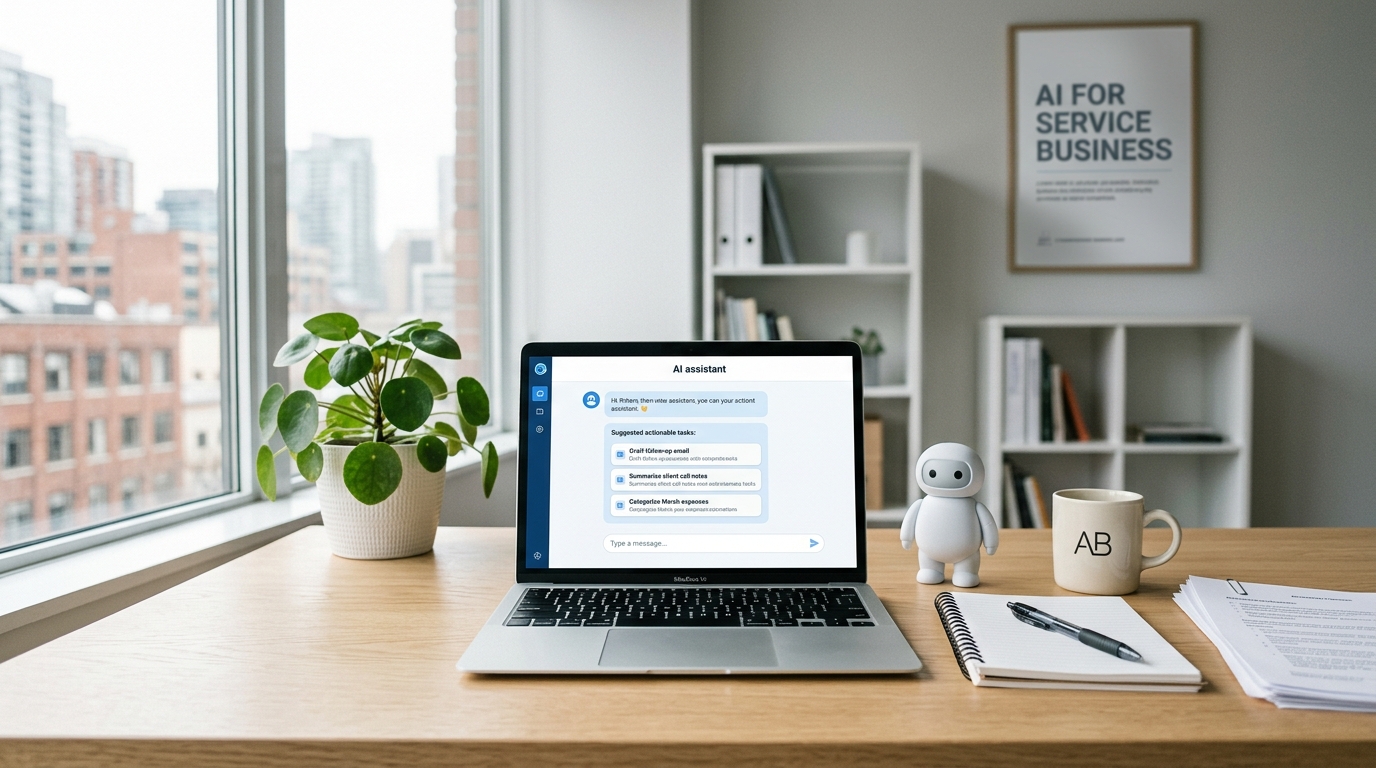
AI for Service Businesses: Real Use Cases to Start Today
You don't need to be a tech company to use AI. The fastest-growing adopters of AI right now aren't SaaS startups — they're exactly who you are: service businesses doing consultative, hands-on, people-work. Agencies, consultancies, practices, coaching businesses, trades.
The key is to stop thinking about AI as a big scary platform and start thinking about it as a set of small, concrete jobs it does well. Here are real AI use cases for service businesses that you can start today, in order from least-scary to most-powerful.
Start with the shallow end: drafting and content
Client and follow-up emails
Drafting is where AI is undeniably, boringly useful. Bump emails, status updates, proposal follow-ups, thank-yous. Give it the context, get a first draft, edit it into your voice. You're cutting the "staring at a blank page" time to nothing.
Content and social media skeletons
Blog drafts, LinkedIn posts, video show notes, service descriptions. AI can produce a competent skeleton in seconds; you supply the expertise and the voice. For busy owners, this turns "I should post more" into something that actually happens.
Summarizing meetings and long documents
Paste in a client call transcript or a 40-page contract and get a clean summary with the action items. This one saves serious time for anyone who reads and replies for a living.
Go a level deeper: operations and client work
Onboarding and proposals
Automated AI-assisted drafting of intake questions, project scopes, and proposal sections means new-client work starts faster and more consistently. Pair it with an automated onboarding workflow and the effect compounds.
Research and drafting the repetitive deliverable
If parts of your client work are formulaic — a standard diagnostic, a boilerplate audit, a recurring report template — AI can draft the first pass. Your real value is the interpretation and recommendations layered on top; AI just gets the scaffolding up.
Categorizing expenses and cleaning data entry
On the finance side, AI-powered categorization takes the pain out of bookkeeping admin, and anomaly detection flags what deserves a human eye. (Read AI for Bookkeeping: What It Actually Does (and What It Can't) for the honest picture.)
The high-value use case: content and marketing at scale for a small team
Here's where service businesses really win. A one-to-three-person firm can now produce the volume of thoughtful content — proposals, case studies, guides, email sequences — that used to require a marketing department. Not by pressing a button and shipping AI slop, but by using AI to draft and a human to feed in real expertise and voice. That's how you become the firm clients find and trust, without hiring a content machine.
Three quick examples of AI removing real hours
Seeing use cases in the abstract is one thing; watching them remove a specific, recurring chore is what makes them stick. Here are three ordinary service-business scenarios where AI genuinely cut admin time:
The solo consultant's follow-up problem. Every week, a consultant sends the same three status emails to active clients — same structure, different names and dates. Instead of writing each from scratch, they draft a reusable template and let AI fill in the specifics: what was completed, what's next, when to expect it. The consultant reviews and hits send. What used to take 40 minutes of staring at a blank page now takes five.
The agency's meeting-note black hole. After every client call, someone had to transcribe notes, chase action items, and worse — reconstruct what was agreed a month later. Adding an AI note-taker to calls produces a clean summary plus assigned next steps automatically. Within a week, agency staff stopped asking "did we decide that?" because the answer is always one search away.
The bookkeeper's monthly reconciliation backlog. A practice receiving hundreds of small transactions each month had a staff member manually sorting and categorizing them — a full, draining morning every month. AI-assisted categorization flagged the obvious ones automatically; the human reviewed only the edge cases and anomalies. The monthly close shrank from several hours to under an hour, with fewer errors.
None of these required becoming a tech company. They're the same work already happening, with AI handling the repetitive scaffolding and a human keeping the judgment.
The rules so AI helps instead of hurts
Three guardrails keep AI use from backfiring:
- Never send AI output unedited for anything that matters. Drafts get eyes. Especially anything financial or client-facing.
- Don't automate the relationship. A check-in, a hard conversation, a negotiation — those stay human. AI impersonating warmth is how clients feel undervalued.
- Keep the accountability human. If it touches money, tax, or a client promise, a person signs off. No exceptions.
How to start today (a 90-day slice)
- Week 1: Set up AI-assisted drafting for follow-up emails. Just that.
- Weeks 2–4: Apply it to meeting summaries and proposal drafts.
- Weeks 5–8: Add automated onboarding and invoice automation so your operations feed clean data.
- Weeks 9–12: Use AI for expense categorization inside your bookkeeping, then review a monthly dashboard of the numbers.
At the end of 90 days, you'll have real hours back — and the data to decide what to automate next. That's the data-driven way: adopt in small steps, measure, and scale what works.
The payoff compounds when the systems underneath are sound. When one fast-growing service company let its books and automation fall behind its revenue, we rebuilt them together — and brought $315,600 back into the financials. Small, measured AI wins are the on-ramp; a clean system is what makes them add up.
Ready to put AI to work in your business?
Get your books right first. AI only helps if the data it works with is accurate. Our bookkeeping team keeps service-business books clean, current, and CRA-ready. Talk to us about monthly bookkeeping.
Get a roadmap for AI and systems. Not sure where AI actually fits your business? Our AI & Systems Implementation service maps your workflows and builds the automation around them. Learn more about AI & Systems Implementation or book a call to map the first step.
Keep reading
- What Is AI Implementation for Small Business (Data Driven Approach) — the framework for scaling these wins
- 11 Ways to Automate Your Service Business (Save Time) — concrete automation ideas
- Systems for Service Businesses: The 5 Core Systems You Need — building it into a real system

AI for Service Businesses: Real Use Cases to Start Today
You don't need to be a tech company to use AI. The fastest-growing adopters of AI right now aren't SaaS startups — they're exactly who you are: service businesses doing consultative, hands-on, people-work. Agencies, consultancies, practices, coaching businesses, trades.
The key is to stop thinking about AI as a big scary platform and start thinking about it as a set of small, concrete jobs it does well. Here are real AI use cases for service businesses that you can start today, in order from least-scary to most-powerful.
Start with the shallow end: drafting and content
Client and follow-up emails
Drafting is where AI is undeniably, boringly useful. Bump emails, status updates, proposal follow-ups, thank-yous. Give it the context, get a first draft, edit it into your voice. You're cutting the "staring at a blank page" time to nothing.
Content and social media skeletons
Blog drafts, LinkedIn posts, video show notes, service descriptions. AI can produce a competent skeleton in seconds; you supply the expertise and the voice. For busy owners, this turns "I should post more" into something that actually happens.
Summarizing meetings and long documents
Paste in a client call transcript or a 40-page contract and get a clean summary with the action items. This one saves serious time for anyone who reads and replies for a living.
Go a level deeper: operations and client work
Onboarding and proposals
Automated AI-assisted drafting of intake questions, project scopes, and proposal sections means new-client work starts faster and more consistently. Pair it with an automated onboarding workflow and the effect compounds.
Research and drafting the repetitive deliverable
If parts of your client work are formulaic — a standard diagnostic, a boilerplate audit, a recurring report template — AI can draft the first pass. Your real value is the interpretation and recommendations layered on top; AI just gets the scaffolding up.
Categorizing expenses and cleaning data entry
On the finance side, AI-powered categorization takes the pain out of bookkeeping admin, and anomaly detection flags what deserves a human eye. (Read AI for Bookkeeping: What It Actually Does (and What It Can't) for the honest picture.)
The high-value use case: content and marketing at scale for a small team
Here's where service businesses really win. A one-to-three-person firm can now produce the volume of thoughtful content — proposals, case studies, guides, email sequences — that used to require a marketing department. Not by pressing a button and shipping AI slop, but by using AI to draft and a human to feed in real expertise and voice. That's how you become the firm clients find and trust, without hiring a content machine.
Three quick examples of AI removing real hours
Seeing use cases in the abstract is one thing; watching them remove a specific, recurring chore is what makes them stick. Here are three ordinary service-business scenarios where AI genuinely cut admin time:
The solo consultant's follow-up problem. Every week, a consultant sends the same three status emails to active clients — same structure, different names and dates. Instead of writing each from scratch, they draft a reusable template and let AI fill in the specifics: what was completed, what's next, when to expect it. The consultant reviews and hits send. What used to take 40 minutes of staring at a blank page now takes five.
The agency's meeting-note black hole. After every client call, someone had to transcribe notes, chase action items, and worse — reconstruct what was agreed a month later. Adding an AI note-taker to calls produces a clean summary plus assigned next steps automatically. Within a week, agency staff stopped asking "did we decide that?" because the answer is always one search away.
The bookkeeper's monthly reconciliation backlog. A practice receiving hundreds of small transactions each month had a staff member manually sorting and categorizing them — a full, draining morning every month. AI-assisted categorization flagged the obvious ones automatically; the human reviewed only the edge cases and anomalies. The monthly close shrank from several hours to under an hour, with fewer errors.
None of these required becoming a tech company. They're the same work already happening, with AI handling the repetitive scaffolding and a human keeping the judgment.
The rules so AI helps instead of hurts
Three guardrails keep AI use from backfiring:
- Never send AI output unedited for anything that matters. Drafts get eyes. Especially anything financial or client-facing.
- Don't automate the relationship. A check-in, a hard conversation, a negotiation — those stay human. AI impersonating warmth is how clients feel undervalued.
- Keep the accountability human. If it touches money, tax, or a client promise, a person signs off. No exceptions.
How to start today (a 90-day slice)
- Week 1: Set up AI-assisted drafting for follow-up emails. Just that.
- Weeks 2–4: Apply it to meeting summaries and proposal drafts.
- Weeks 5–8: Add automated onboarding and invoice automation so your operations feed clean data.
- Weeks 9–12: Use AI for expense categorization inside your bookkeeping, then review a monthly dashboard of the numbers.
At the end of 90 days, you'll have real hours back — and the data to decide what to automate next. That's the data-driven way: adopt in small steps, measure, and scale what works.
The payoff compounds when the systems underneath are sound. When one fast-growing service company let its books and automation fall behind its revenue, we rebuilt them together — and brought $315,600 back into the financials. Small, measured AI wins are the on-ramp; a clean system is what makes them add up.
Ready to put AI to work in your business?
Get your books right first. AI only helps if the data it works with is accurate. Our bookkeeping team keeps service-business books clean, current, and CRA-ready. Talk to us about monthly bookkeeping.
Get a roadmap for AI and systems. Not sure where AI actually fits your business? Our AI & Systems Implementation service maps your workflows and builds the automation around them. Learn more about AI & Systems Implementation or book a call to map the first step.
Keep reading
- What Is AI Implementation for Small Business (Data Driven Approach) — the framework for scaling these wins
- 11 Ways to Automate Your Service Business (Save Time) — concrete automation ideas
- Systems for Service Businesses: The 5 Core Systems You Need — building it into a real system
CONNECT WITH US
COPYRIGHT © 2026 BOTTCHER GROUP OF COMPANIES
8661 201st Street, 2nd Floor, Langley, BC, V2Y 0G9, Canada