
Service Based Business Society Blog
ENTREPRENEUR ARTICLES AND RESOURCES
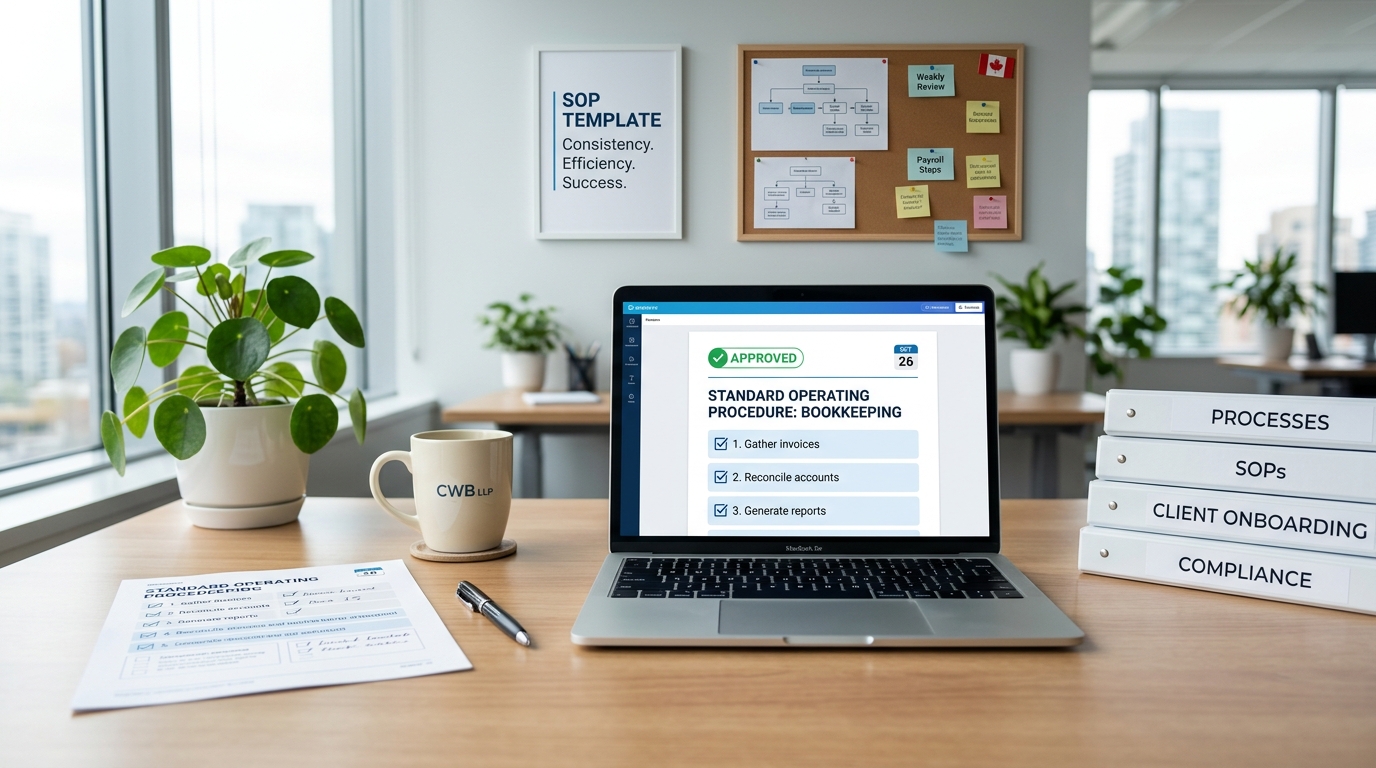
An SOP Template for Service Businesses
Here's a question that separates growing service businesses from stuck ones: if you couldn't work for a month, would your business still run?
For most owners, the honest answer is no — or "it would limp along badly." The reason isn't that you're irreplaceable at every task. It's that the knowledge of how things work lives only in your head. The process for onboarding a client, delivering a project, or doing the monthly books isn't written down anywhere. It's a system of one, and it doesn't scale.
Standard operating procedures — SOPs — solve this. They turn "everyone kind of knows how it works" into "here is exactly how it works, so anyone can do it." And the payoff goes beyond delegation: documented processes are the foundation for automation, because you can't automate what you can't describe.
Here's a practical SOP template for service businesses, plus how to write one without it being a month-long project.
What an SOP actually is (and isn't)
An SOP is a clear, repeatable set of instructions for doing a task the way your business wants it done. It's not a novel. It's not aspirational strategy. It's the "here's how we do X, step by step" reference that means a task no longer depends on one person.
The most useful SOPs are for tasks you do repeatedly and consistently: onboarding a client, sending an invoice, responding to an inquiry, running a monthly report, doing a specific deliverable.
The SOP template (fill in the sections)
1. Task name & purpose
One line: what this SOP is for, and why it exists. ("Onboard a new retainer client — ensures they get all intake materials and a smooth kickoff.")
2. Owner & when it runs
Who owns this process? Under what trigger does it run? ("Owner: Client Ops. Trigger: signed proposal received.")
3. Tools involved
List everything the task uses — software, templates, links. Nothing derails a task like hunting for the right form.
4. Inputs
What does this task need before it starts? (A signed proposal, the client's contact info, their intake answers.)
5. Step-by-step procedure
The actual how-to. Number the steps. Include the tedious details people forget: where the file lives, the subject line format, which fields to fill. A step that assumes knowledge is a step that fails in your absence.
6. Outputs
What does "done" look like? (Client welcome email sent, account created, onboarding checklist checked off.)
7. Quality checks
How do you know it was done right? (Verify the contact has all intake materials, confirm the client replied to the welcome email.)
8. Common mistakes
Short list of what usually goes wrong, so the person doing it avoids the trap. ("Don't skip the deposit invoice — it's required before kickoff.")
9. Last reviewed
A date. Processes drift; SOPs need revisiting, ideally twice a year.
That's it. Nine fields. Most useful SOPs fit on one to two pages.
How to write them without losing a week
The biggest barrier to SOPs is that they feel like a huge project. They don't have to be. Here's the workflow:
- Pick the two or three highest-pain tasks — the ones you do most often or that hurt most when done wrong. Invoicing and onboarding are the usual suspects.
- Do the task and narrate it — as you do it normally, screen-record or write out each step. You're not writing from memory; you're documenting reality.
- Turn the notes into the template — you've already got the raw steps. Slot them into the structure above.
- Have someone else run it — the acid test. Hand the SOP to a teammate (or your future self) and see if they can execute it. Where they get stuck is where the SOP needs more detail.
Start small. One excellent SOP beats ten half-written ones that no one uses.
Where documentation meets automation
Here's the through-line that makes documentation exciting rather than tedious: you can't automate a process you can't describe. The SOP is the blueprint. Once you've documented the workflow, you can see exactly which steps are rule-based and repeatable — the ones begging for automation — and which need a human.
That's the bridge from "documenting processes" to "building systems" to "implementing AI and automation." It's why SOPs are step one in our AI & Systems Implementation work. Get the process down on paper, and automation becomes a wiring job instead of a mystery.
It's also where the financial payoff shows up. When a service company's systems had never been documented or connected, job costs and profitability were invisible — and untangling it took a full rebuild that delivered a 10X return on the engagement. Documented, repeatable processes are what make an operation both audit-proof and worth automating.
Ready to turn your process into a system?
Get your books right. Clean, consistent financial processes are an SOP in their own right. Our bookkeeping team builds and maintains them. Talk to us about monthly bookkeeping.
Go from documentation to automation. We'll help you document your workflows, build the systems, and wire in AI and tools. Learn more about AI & Systems Implementation or book a call to get started.
One last principle: an SOP is only as good as its last update. Set a recurring reminder to review each one quarterly, and put the owner's name and a "last reviewed" date at the top of every document. Processes drift, tools change, and a stale SOP quietly teaches the wrong way to do things. Treat your documentation as living, and it becomes the backbone your business can actually scale on.
Keep reading
- Systems for Service Businesses: The 5 Core Systems You Need — the bucket these processes live in
- How to Automate Your Service Business Operations — automating what you've documented
- Client Onboarding Automation for Service Businesses — the SOP that pays off fastest

An SOP Template for Service Businesses
Here's a question that separates growing service businesses from stuck ones: if you couldn't work for a month, would your business still run?
For most owners, the honest answer is no — or "it would limp along badly." The reason isn't that you're irreplaceable at every task. It's that the knowledge of how things work lives only in your head. The process for onboarding a client, delivering a project, or doing the monthly books isn't written down anywhere. It's a system of one, and it doesn't scale.
Standard operating procedures — SOPs — solve this. They turn "everyone kind of knows how it works" into "here is exactly how it works, so anyone can do it." And the payoff goes beyond delegation: documented processes are the foundation for automation, because you can't automate what you can't describe.
Here's a practical SOP template for service businesses, plus how to write one without it being a month-long project.
What an SOP actually is (and isn't)
An SOP is a clear, repeatable set of instructions for doing a task the way your business wants it done. It's not a novel. It's not aspirational strategy. It's the "here's how we do X, step by step" reference that means a task no longer depends on one person.
The most useful SOPs are for tasks you do repeatedly and consistently: onboarding a client, sending an invoice, responding to an inquiry, running a monthly report, doing a specific deliverable.
The SOP template (fill in the sections)
1. Task name & purpose
One line: what this SOP is for, and why it exists. ("Onboard a new retainer client — ensures they get all intake materials and a smooth kickoff.")
2. Owner & when it runs
Who owns this process? Under what trigger does it run? ("Owner: Client Ops. Trigger: signed proposal received.")
3. Tools involved
List everything the task uses — software, templates, links. Nothing derails a task like hunting for the right form.
4. Inputs
What does this task need before it starts? (A signed proposal, the client's contact info, their intake answers.)
5. Step-by-step procedure
The actual how-to. Number the steps. Include the tedious details people forget: where the file lives, the subject line format, which fields to fill. A step that assumes knowledge is a step that fails in your absence.
6. Outputs
What does "done" look like? (Client welcome email sent, account created, onboarding checklist checked off.)
7. Quality checks
How do you know it was done right? (Verify the contact has all intake materials, confirm the client replied to the welcome email.)
8. Common mistakes
Short list of what usually goes wrong, so the person doing it avoids the trap. ("Don't skip the deposit invoice — it's required before kickoff.")
9. Last reviewed
A date. Processes drift; SOPs need revisiting, ideally twice a year.
That's it. Nine fields. Most useful SOPs fit on one to two pages.
How to write them without losing a week
The biggest barrier to SOPs is that they feel like a huge project. They don't have to be. Here's the workflow:
- Pick the two or three highest-pain tasks — the ones you do most often or that hurt most when done wrong. Invoicing and onboarding are the usual suspects.
- Do the task and narrate it — as you do it normally, screen-record or write out each step. You're not writing from memory; you're documenting reality.
- Turn the notes into the template — you've already got the raw steps. Slot them into the structure above.
- Have someone else run it — the acid test. Hand the SOP to a teammate (or your future self) and see if they can execute it. Where they get stuck is where the SOP needs more detail.
Start small. One excellent SOP beats ten half-written ones that no one uses.
Where documentation meets automation
Here's the through-line that makes documentation exciting rather than tedious: you can't automate a process you can't describe. The SOP is the blueprint. Once you've documented the workflow, you can see exactly which steps are rule-based and repeatable — the ones begging for automation — and which need a human.
That's the bridge from "documenting processes" to "building systems" to "implementing AI and automation." It's why SOPs are step one in our AI & Systems Implementation work. Get the process down on paper, and automation becomes a wiring job instead of a mystery.
It's also where the financial payoff shows up. When a service company's systems had never been documented or connected, job costs and profitability were invisible — and untangling it took a full rebuild that delivered a 10X return on the engagement. Documented, repeatable processes are what make an operation both audit-proof and worth automating.
Ready to turn your process into a system?
Get your books right. Clean, consistent financial processes are an SOP in their own right. Our bookkeeping team builds and maintains them. Talk to us about monthly bookkeeping.
Go from documentation to automation. We'll help you document your workflows, build the systems, and wire in AI and tools. Learn more about AI & Systems Implementation or book a call to get started.
One last principle: an SOP is only as good as its last update. Set a recurring reminder to review each one quarterly, and put the owner's name and a "last reviewed" date at the top of every document. Processes drift, tools change, and a stale SOP quietly teaches the wrong way to do things. Treat your documentation as living, and it becomes the backbone your business can actually scale on.
Keep reading
- Systems for Service Businesses: The 5 Core Systems You Need — the bucket these processes live in
- How to Automate Your Service Business Operations — automating what you've documented
- Client Onboarding Automation for Service Businesses — the SOP that pays off fastest
CONNECT WITH US
COPYRIGHT © 2026 BOTTCHER GROUP OF COMPANIES
8661 201st Street, 2nd Floor, Langley, BC, V2Y 0G9, Canada